
In my effort to understand the many ways politics interact with social media, I have dedicated a lot of my time studying social media influencers. Specifically, their potential to mobilise their followers on and offline.
In one of the many conversations I had with peers on this subject, I was asked to construct a model based on some of my conclusions. It seems the best idea to provide a starting point for active discussion on a wider scale.
So, this represents a working paper. It touches upon various topics but focuses on trying to identify explanations relating to social media personalities. It serves the purpose to kick off a discussion about the role of influencers in politics, and their potential for mobilisation.
I want to try to approach this from a different angle, since I already designed a study with the intention of tracing the impact social media influencers have on politics online and offline quantitatively. In short, the previous study consisted of tracking the various channels and posts of a selected number of influencers over a fixed period. Call to actions were singled out for further analysis and comparison. Data was collected based on specific data points and coded for later statistical evaluation. This was rounded out by an additional network and sentiment analyses to highlight reach and tone.
Obviously, there was the obstacle of not having direct access to data on internet platforms, and this won’t change for some time until DSA will finally be fully ratified. So, I want to try something else and approach this from a different angle. My focus will be on dynamics – meaning, I am going to explain the causality of how social media influencers can mobilise their followers in terms of mechanisms and processes.
Why mechanisms and processes?
Dynamics = mechanisms / processes
To be on the same page, a definition:
- Mechanisms are events that produce the same immediate effect over a wide range of circumstances.
- Processes are combinations and sequences / constellation of mechanisms that produce some specified outcome.
Identifying mechanisms and processes make for an interesting and different perspective that I have used extensively in my previous research on social movements. There are two positive aspects that I want to highlight in respect to dynamical explanations. Identified mechanisms and processes provide causal explanation and are portable across various settings.
Meaning:
- Findings tell me why some events produce the same effect, and
- identified mechanisms and processes can also be applied to other fields beyond politics.
Social media influencers are deviants
I came across Basma Albanna’s work on positive deviance, and it provided me with a theoretical justification for studying social media influencers. The positive deviance approach focuses on outliers, so called “deviants” to uncover why they are successful.
I see social media influencers as deviants that are successful in mobilising their followers on & offline. They successfully grew a community of followers that gains them high reach. Something that is achieved most often by sharing content that may inspire, entertain, inform, educate, etc.
Influencers: social media personalities with a high reach
There is no direct formula, but there are some conclusions that I have drawn from my previous study.
A lot of times, influencers have grown their communities by combining three strategies:
- sharing private impressions on a specific topic or themselves (staged or not doesn’t really make a difference),
- capturing attention, and driving engagement by continuously sharing impactful posts,
- strong interaction with their followers.
Obviously, depending on who you investigate, there may be more or different factors or ways of how this level of high reach in terms of followers was achieved. There is also no specified timeframe that can be set. What I can say, is that in my experience, influencers who have grown their followers organically over time have a more loyal and sustainable community than others that may have had viral hits.
There are more factors to consider that I won’t get into too much, because the focus lies in finding dynamical explanations, and this would widen the scope significantly. But I want to mention a couple of things that I find interesting. For instance, content creators often adapt posts after experiencing a surge in engagement and churn out similar or related content “to ride on this waive” of engagement, which often is associated with growth or maintaining reach. The learning curve suggests a flexibility in either adapting to formats and timings of sharing posts, but also content that generates more engagement.
We already know about the many detrimental effects that the ‘meaningful interaction’ based algorithm by Facebook causes. It also appears to rank posts according to four signals: relationship (who a user typically interacts with); content type (the type of media in the post); popularity (how many likes/engagements a post gets); and recency (newer posts are shown first),
It affects all users, which includes content creators with high reach. For instance, have you heard about the populist feedback loop? It describes the effect when political leaders and influencers are taking more partisan positions to optimise for reach and attract more interaction, because outrageous content generates more engagement. So there is a two-way dynamic at play, social media doesn’t only affect a users’ consumption of content, but also content creators sharing posts.
Dynamics at play
How does high reach come about?
Getting back on track in terms of providing dynamical explanations, I took a closer look at why some content creators grow their community of followers and achieve high reach.
We know that social media influencers are highly successful in creating (emotional) connections with previously unconnected people. There is a mechanism that is associated with the skill of creating connections between previously unconnected sites – brokerage.
In general, social media personalities remain in control of how people perceive them through their posts, because they can edit and curate their content. Content creators excel at brokerage. It allows them to build an emotional connection with other users, who then become their followers. Their posts convey a sense of authenticity to their followers and is an integral part of the (emotional) connection they share with them and is part of brokerage.
This skill, which led them to create emotional connections through a sense of authenticity is also the reason why influencers are so valuable to brands, and influencer marketing has become a profitable and indispensable tool.
So, social media influencers are expert brokers and community builders. By staging themselves as a personal brand, influencers become permanent fixtures within the subject areas that are important to their target groups, and beyond.
How do influencers mobilise their followers?
We already established that high reach translates into having successfully grown a large community of followers. Emotional connections were created through the mechanism brokerage and lead to successful community building. I want to go as far and say, that social media influencers are brokers, which means that all their content serves the goal of creating emotional connections, consciously done or not.
Social media influencers create content that is shared with their community. When this happens, ideas, impressions, issues flow from the content creator to their followers. Because of the high reach, the mechanism associated with this is diffusion, which describes the spread of ideas, impressions, or issues, etc. from one site to another.
Whenever shared content includes a call to action, e.g., showing support, raising awareness to issues, petitioning, or mobilising offline, and followers follow this call, the mechanism coordination is in play. It describes an event where various sites engage in parallel, in this case, various users follow the call to action.
In the case of social media influencers, the three identified mechanisms are prerequisites to mobilisation and result in coordinated action as the visualisation below suggests. But they do not represent all dynamics at play, just the basic underlying ones of coordinated action.
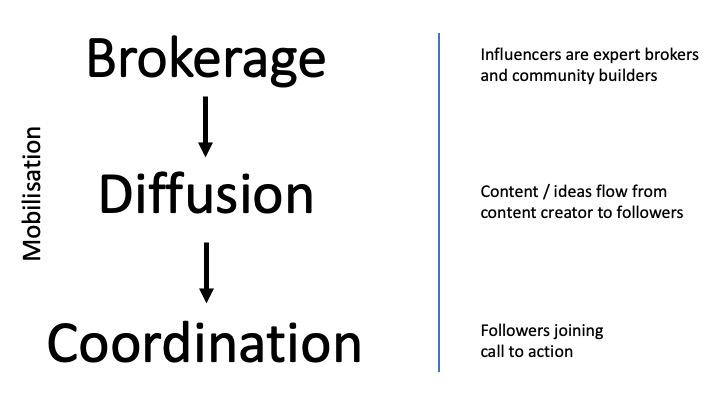
Sites of coordinated action
Depending on the call to action, you might find other mechanisms and their combinations – processes – explaining causality. For instance, what if several influencers decide to make the same call to action? Or another influencer joins the other later? In this case, brokers are creating alliances, which is a process that describes creating new, visible, and direct coordination, between previously distinct actors.
So, when this newly created alliance of brokers publishes a call to action, diffusion of ideas has an even larger reach, and might lead to an increased level of coordination by followers, which in turn points to the process upward scale shift.
I think what is obvious here, is that there is a lot of room left for exploring why influencers can mobilize their followers. In addition, I need to point out that I left out the structural factor completely. Obviously, the level of mobilization and its success also depends on the situation at hand, as well as the political opportunities present.
The next step would be to look into specific influencers and single out calls to action to identify case-specific dynamics at play, and at the same time include a structural analysis to complement the picture. But as I said, this working paper represents a starting point for further discussion, and I look forward to see where this goes.
 brave new digital space
Leave a comment